AlphaScopeNote · Korean Securities Guide
Samsung Electronics Common vs Preferred Shares: 005930 vs 005935
Samsung Electronics has two major local share classes tied to the same operating company but carrying different voting, dividend and liquidity characteristics. This guide maps the Korean tickers, explains the unusually small dividend preference, and uses AlphaScope data to put the preferred-share discount in context. This article explains Samsung Electronics common 005930 and preferred 005935 as traded in Korea.
Last reviewed: · Market data through August 4, 2026
The short answer
005930 on KRX
Samsung common shares
The standard voting security, with substantially greater trading value and direct participation in shareholder votes.
005935 on KRX
Samsung preferred shares
A non-voting, non-cumulative class entitled to only KRW 1 more in annual cash dividend under the current par value.
Before we begin: what are common and preferred shares?
Common and preferred shares are separate classes issued by the same company with different rights. The company's sales and earnings come from the same business, but shareholder rights and the market prices of the two classes do not have to be identical.
Common shares
The basic share class, generally carrying shareholder-meeting voting rights and receiving dividends declared by the board.
Preferred shares
A class that may limit voting rights in exchange for preference in dividends, residual assets or another specified right. Terms differ by issuer and security.
The exact differences between Samsung's two shares
| Feature | Common 005930 | Preferred 005935 |
|---|---|---|
| KRX code | 005930 | 005935 |
| Share class | Common | Preferred |
| ISIN | KR7005930003 | KR7005931001 |
| Voting rights | Normally one vote per share | Normally non-voting |
| Cash-dividend term | Ordinary dividend declared by Samsung | Annual priority equal to 1% of par value above common |
| Current par value | KRW 100 per share | |
| Current annual preference | — | KRW 1 per share |
| Cumulative? | Not applicable | No |
| Convertible or redeemable? | Not applicable | Not an ordinary convertible or redeemable preferred |
| Q1 2026 issued shares | 5,919,637,922 | 815,974,664 |
| Q1 2026 shares in circulation | 5,792,563,304 | 802,371,203 |
Security identifiers and share counts come from Samsung's official listing page and Q1 2026 report. Repurchases, cancellations and other corporate actions can change the counts after the reporting date.
This is different from one share trading on KRX and NXT
The two concepts are often confused. When Samsung common 005930 trades on both KRX and Nextrade (NXT), the same security is trading at two execution venues. By contrast, 005930 and 005935 are two separate securities with different rights, even though the same company issued them.
Moving from 005930 to 005935 therefore requires selling one security and buying the other. It is not the same as buying 005930 on NXT and selling the same 005930 position on KRX. The venue question is covered separately in KRX vs Nextrade.
Why is the extra KRW 1 not the main dividend story?
Samsung's preferred term equals 1% of a KRW 100 par value: just KRW 1 per year. It is not KRW 1 extra every quarter. In 2025, the first three quarterly dividends were identical for both classes; the final dividend was KRW 566 for common and KRW 567 for preferred, creating the annual KRW 1 difference.
| Record year | Common | Preferred | Difference |
|---|---|---|---|
| 2019 | KRW 1,416 | KRW 1,417 | KRW 1 |
| 2020 | KRW 2,994 | KRW 2,995 | KRW 1 |
| 2021 | KRW 1,444 | KRW 1,445 | KRW 1 |
| 2022 | KRW 1,444 | KRW 1,445 | KRW 1 |
| 2023 | KRW 1,444 | KRW 1,445 | KRW 1 |
| 2024 | KRW 1,446 | KRW 1,447 | KRW 1 |
| 2025 | KRW 1,668 | KRW 1,669 | KRW 1 |
The 2020 total includes Samsung's special dividend. Historical dividends do not establish a future payout.
Common: 1,668 ÷ 240,000 = 0.70% · Preferred: 1,669 ÷ 176,400 = 0.95%
This is a historical-dividend-to-later-price illustration, not a forward yield forecast. At the August 4 preferred price, the extra KRW 1 adds only about 0.0006 percentage points of yield. Nearly all the illustrated yield gap comes from the preferred share's lower purchase price.
What really makes the preferred dividend yield higher?
Dividend yield has a numerator and a denominator. Samsung's preferred receives only KRW 1 more in annual cash dividend, while its quoted market price can be tens of thousands of won below the common share. The lower denominator, not the extra KRW 1, creates nearly all of the observed yield gap.
| Component | Common | Preferred |
|---|---|---|
| Cash dividend per share | KRW 1,668 | KRW 1,669 |
| Contractual difference | Base class | KRW 1 |
| Comparison close | KRW 240,000 | KRW 176,400 |
| Simple yield | 0.70% | 0.95% |
At a hypothetical identical KRW 240,000 price, the one-won preference would add roughly 0.0004 percentage points of yield. Even with an identical dividend, a KRW 176,400 purchase price would produce about a 0.95% yield. The economically useful description is therefore buying a similar cash-dividend stream at a lower equity price.
Why can the two market prices diverge?
The two classes share Samsung's earnings and capital-allocation policy, but they do not offer the same rights or trading conditions. The discount is better viewed as the combined outcome of several changing channels than as one fixed penalty.
Voting value
Common holders can normally vote on directors, mergers, amendments and capital actions. Governance events can change the market value assigned to that right.
Depth and execution
Higher turnover and deeper books make it easier to move large common-share positions. Preferred orders may incur greater spread and market-impact costs.
Investor clientele
Foreign, institutional and retail ownership differs by class. Changes in income demand, governance mandates and tactical flows can move relative prices.
Index and product flows
Class eligibility for benchmarks, ETFs, futures and options can generate mechanical demand. Investors should verify each product's current methodology and constituents.
Treasury-share actions
A company may repurchase or cancel different quantities of each class. Compensation shares held for later distribution do not have the same effect as cancellation.
Market sentiment and recognition
Security recognition and investor risk appetite can affect relative prices. In a fast market, demand may also concentrate in the more liquid common share.
These are plausible pricing channels, not proof that any single factor caused the discount on a particular date.
How do you calculate the preferred-share discount?
Compare both closing prices on the same date and use the common share as the base. Korean market commentary may call this a preferred discount or a common-preferred price gap.
Preferred discount = (common price − preferred price) ÷ common price × 100
AlphaScope recorded August 4, 2026 closes of KRW 240,000 for 005930 and KRW 176,400 for 005935. The resulting discount was 26.5%; equivalently, the preferred traded at 73.5% of the common price. Those two percentages describe the same relationship but are not interchangeable labels.
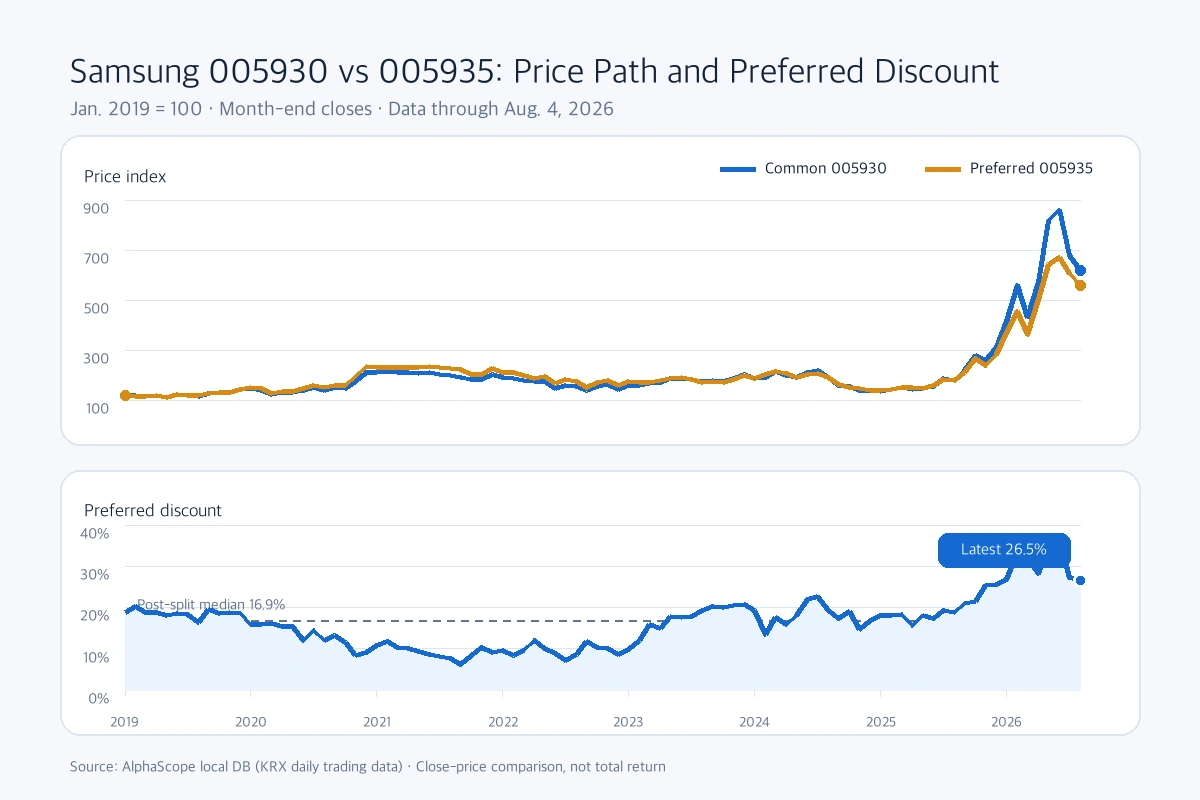
What does the post-split history show?
We paired 2,022 daily closes from the May 4, 2018 split listing through August 4, 2026. The discount moved through a wide range; it was not anchored to the extra dividend amount or to one stable “fair” level.
Half the observations were below this level and half above.
The historical spread makes a single normal discount difficult to defend.
The 26.5% discount exceeded 93.6% of the paired daily observations.
An uncommon reading does not create a contractual convergence trade.
Daily returns had a 0.9146 correlation, consistent with both securities representing the same operating company. The residual difference can reflect voting value, investor clientele, index and flow effects, liquidity, expected dividends and changing risk appetite. The data establish co-movement, not a guaranteed arbitrage relationship.
Does a wide preferred discount automatically mean “cheap”?
The discount is a relative price against Samsung common, not an intrinsic valuation of Samsung Electronics. A preferred at a 30% discount can still be expensive if the common itself embeds unrealistic earnings or capital-allocation assumptions. A smaller discount does not prevent both classes from being absolutely undervalued.
Convergence path 1
Preferred rises faster
New preferred demand can produce the profitable convergence investors expect, but no maturity or redemption clause forces that path.
Convergence path 2
Common falls faster
The percentage gap narrows while the preferred holder still loses money. Spread compression and positive investment return are different outcomes.
No convergence
The discount persists or widens
Voting, benchmark eligibility, access and liquidity differences can remain structural for years.
Value Samsung before valuing the spread
Test earnings, cash flow, semiconductor-cycle and capital-allocation assumptions for both securities.
Measure level and duration
Compare the discount with its historical range and examine how long earlier extremes persisted.
Define a catalyst and a failure case
Identify what could change relative demand and what you will do if the discount grows instead.
How should long-run performance be compared?
Price appreciation alone omits the feature that attracts many preferred investors: cash distributions. Total return combines price change and dividends. A reinvested-dividend total return, a cash-dividend holding return and an after-tax base-currency return are different measures, so comparisons must use the same convention.
Simple holding return = (ending price − starting price + cash dividends) ÷ starting price × 100
| Measure | Common | Preferred |
|---|---|---|
| Starting close | KRW 38,750 | KRW 31,600 |
| Ending close | KRW 240,000 | KRW 176,400 |
| 2019–2025 cash dividends | KRW 11,856 | KRW 11,863 |
| Price return | 519.35% | 458.23% |
| Price + recorded-dividend return | 549.95% | 495.77% |
In this partial comparison, the common's greater price appreciation outweighed the preferred's extra one won per year. That does not establish permanent common-share superiority; it demonstrates that higher dividend yield and higher total return are not synonyms. Different entry and exit dates can reverse the comparison.
How different are trading volume and ease of execution?
The preferred share also trades at large-cap scale, but its trading value is lower than the common share's. Over the final 20 calendar days through August 4, 2026, average daily trading value was approximately KRW 8.05 trillion for common and KRW 785.4 billion for preferred. In a fast market, differences in displayed depth, spreads and the impact of large orders can widen.
| Year | Common | Preferred | Preferred/common |
|---|---|---|---|
| 2019 | 5,069 | 491 | 9.7% |
| 2020 | 12,547 | 1,365 | 10.9% |
| 2021 | 15,048 | 1,293 | 8.6% |
| 2022 | 9,231 | 615 | 6.7% |
| 2023 | 9,167 | 623 | 6.8% |
| 2024 | 15,377 | 916 | 6.0% |
| 2025 | 14,127 | 1,174 | 8.3% |
| 2026 YTD | 72,443 | 7,756 | 10.7% |
2026 YTD covers 143 trading days through August 4; unusually high turnover makes it non-comparable with a full calendar year.
- Small market order: both may normally execute without difficulty, but check the best quote and displayed size rather than only the last trade.
- Large order: aggregate size across price levels to estimate the average execution price. Preferred-share slippage may be larger even when headline turnover looks sufficient.
- Fast market: resting quotes can be cancelled, so past daily turnover may not represent immediately executable liquidity. Consider limits and split orders.
- Exit plan: estimate the market impact of selling the intended position, not only the ease of entering it.
Does a voting right matter to a small investor?
Common holders normally vote on director elections and other shareholder-meeting matters; preferred holders ordinarily do not. A minority investor may assign little private value to one vote, but the market can still price governance rights collectively, especially around control, restructuring or shareholder-return decisions.
Low day-to-day private value
One minority vote rarely determines an ordinary resolution. A passive income investor may rationally place more weight on entry price and yield.
Potentially high event value
Director elections, mergers, spin-offs, charter amendments and capital actions aggregate votes across shareholders. Institutional voting policies and activist proposals can make the right economically relevant.
Samsung's Q1 2026 ownership disclosure showed foreign investors at 47% of common shares and 73% of preferred shares. Domestic individuals represented 16% and 20%, respectively. These figures describe different holder bases; they do not prove why any group prefers one class or make either security safer.
How do buybacks and cancellations apply to the two classes?
A headline announcing a Samsung buyback is incomplete without the class, purpose and final treatment. Common and preferred are separate securities, so Samsung discloses quantities and expenditure by class. A purchase directly changes demand and available float for the class bought; its effect on the other class is indirect unless that class is also included.
| Treatment | Effect on shares | Investor check |
|---|---|---|
| Held in treasury | Tradable float falls, but issued shares do not immediately disappear. | Stated purpose and later disposal or cancellation plan |
| Cancelled | The issued count of that class is permanently reduced. | Class-specific quantity and effective date |
| Granted or disposed | Treasury shares can return to circulation, unlike a cancellation. | Recipients, quantity, price and dilution |
On March 30, 2026, Samsung's board decided to cancel 73,359,314 common shares and 13,603,461 preferred shares repurchased under its 2025 resolutions; the cancellation took effect on April 2. Samsung disclosed that the cancellation reduced the share count without reducing stated capital because the shares had been acquired within distributable profits.
By contrast, common shares acquired for employee equity compensation may later be granted and should not be modeled as a permanent reduction on the purchase date. Read the disclosure chain as purpose → quantity by class → cancellation or disposal → completion result.
A practical decision framework
Common may fit better when
Voting and execution matter
You value governance participation, deeper turnover, institutional-flow exposure or lower market impact for a large position.
Preferred may fit better when
Price and income dominate
You do not need voting rights and accept a potentially persistent discount in exchange for a lower entry price and higher yield at the same dividend policy.
Reassess both when
The spread is your only thesis
Both classes share Samsung's earnings, semiconductor-cycle and capital-allocation risk. A relative discount does not make the operating company absolutely cheap.
In practice, do not stop at “the preferred is cheaper by a certain percentage.” Consider the expected dividend, after-tax return, trading costs, holding period, intended exit size and a scenario in which the discount persists.
Common misconceptions
“The preferred gets a much bigger dividend”
The contractual annual difference is currently KRW 1. Its higher yield primarily reflects the lower market price.
“005935 is a bond-like preferred”
It has no fixed coupon or maturity and remains exposed to Samsung's equity risk.
“The discount must revert to its average”
There is no maturity or redemption date forcing convergence. Historical medians are context, not a promise.
“005930 and 005935 are the same share on two exchanges”
They are separate share classes. KRX versus NXT is the separate question of where one eligible security is executed.
“All preferred shares rank the same in liquidation”
Rights are issuer-specific. Do not assign Samsung a term borrowed from another company's preferred security.
“A high foreign-ownership ratio makes 005935 safer”
Holder composition does not remove company, industry, liquidity, currency or policy risk.
Before placing an order
- Security code: verify whether the order screen shows 005930 or 005935.
- Rights: read the latest periodic report for voting and preferential-dividend terms.
- Expected dividend: do not assume last year's dividend will continue unchanged.
- Simultaneous prices: calculate the discount from common and preferred quotes at the same time.
- Historical range: review the minimum, maximum and duration as well as the average discount.
- Liquidity: check trading value, best-quote size and the bid-ask spread.
- Company value: assess the semiconductor cycle, earnings, cash flow and capital allocation first.
- Tax and costs: reflect dividend tax, trading costs and the rules applicable to the account.
Frequently asked questions
Does 005935 receive KRW 1 extra every quarter?
No. The current preference is annual. Recent practice has shown equal interim dividends and the additional KRW 1 in the final dividend, but each declared dividend should be checked.
Can preferred holders vote?
Samsung describes the class as non-voting under ordinary conditions. Statutory exceptions or class-right matters may require reviewing the latest articles and disclosure for the specific event.
Is a 26.5% discount automatically attractive?
No. It was high relative to the post-split history, but the gap may widen or persist, and both share prices can fall if Samsung's value declines.
Do the two classes always move together?
They usually respond to the same company news, but flows and liquidity differ. Their post-split daily-return correlation in AlphaScope was 0.9146—not 1.0.
Does buying Samsung preferred provide the same exposure to Samsung's results?
Both classes are exposed to the performance of the same Samsung Electronics business. Their investment results can still differ because voting rights, dividend preference, price and liquidity are different.
Where can I verify current dividends and rights?
Use Samsung Investor Relations for listing and shareholder-return information, Samsung's latest periodic report, and Korea's DART filing system for dividend and corporate disclosures.
Key takeaways
- 005930 is Samsung's voting common share; 005935 is a normally non-voting, non-cumulative preferred share.
- The current annual dividend preference is only KRW 1, so the market-price discount drives most of the yield difference.
- The August 4, 2026 discount of 26.5% ranked high in post-split history, but convergence is not contractual.
- Total return can rank the classes differently from dividend yield because entry price, price appreciation and the changing discount all matter.
- Common-share trading value is much larger, which can matter for spreads and sizable orders.
- Voting and treasury-share actions apply differently by class and should be read from the underlying disclosure.
- Valuing Samsung and the price paid should come before choosing the share class.