AlphaScope Note · Korea market guide
When must you buy
a Korean stock for its dividend?
A practical guide to Korea’s record date, ex-dividend date, settlement cycle and changing dividend procedure—explained with calendars.
The short answer
Think about when the trade settles,
not merely the record date.
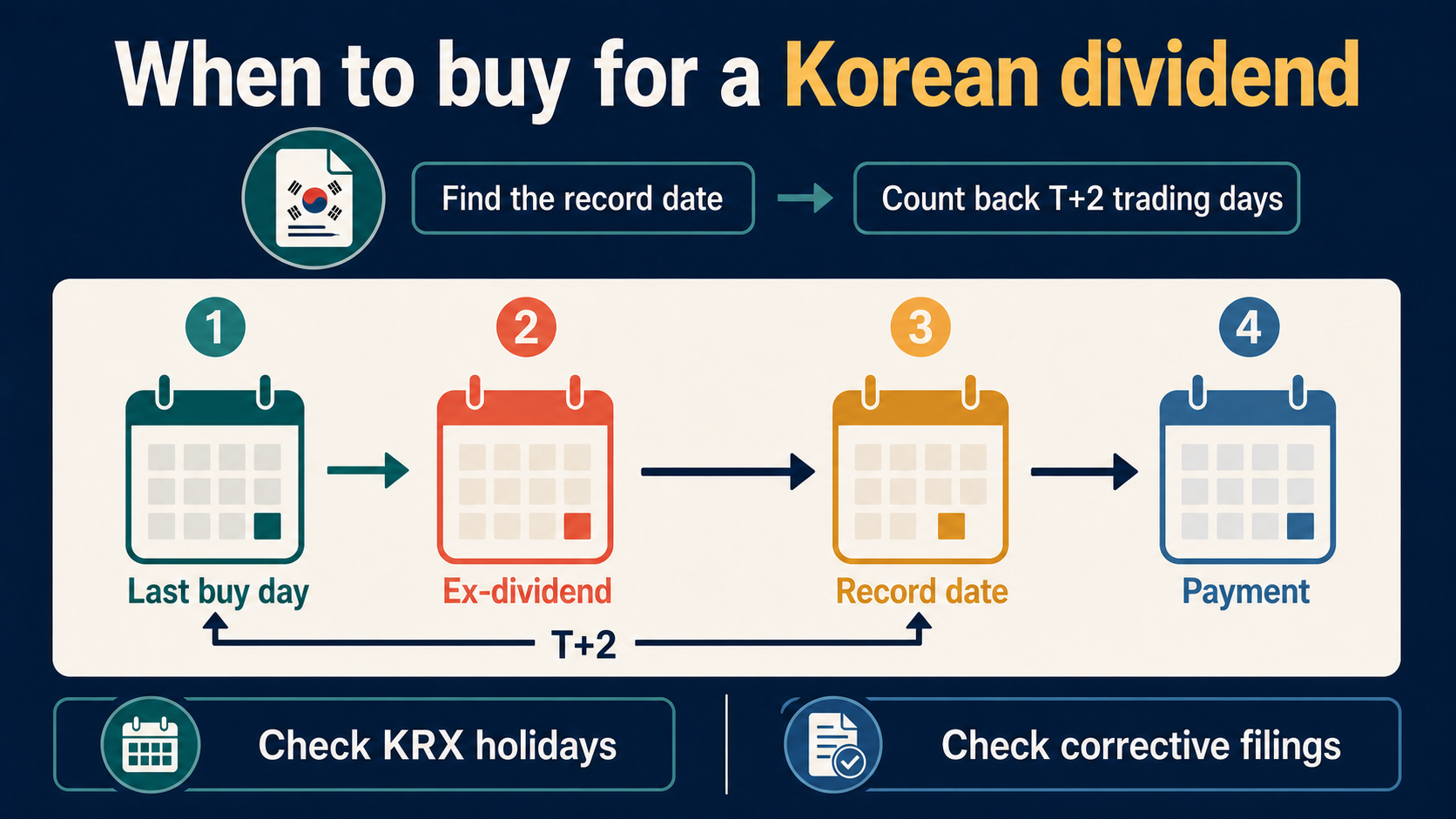
As of August 11, 2026, regular-way Korean stock trades generally settle on T+2. To qualify for a dividend, count backward in Korean trading days so your purchase settles by the company’s record date.
See it on a calendar
If the record date is Thursday, when is the last day to buy?
Assume fictional Company A sets Thursday, April 16, 2026 as its record date and there are no Korean market holidays in between.
T+1 is not in effect in Korea. The T+1 view is only a hypothetical comparison showing how the calculation could change after a future transition. Use T+2 for current Korean dividend dates.
Current T+2 rule: a purchase on Tuesday, April 14 settles on Thursday the 16th. April 14 is the last day to buy; April 15 is the ex-dividend date.
Settled by record date · eligible
Settles after record date · not eligible
KRX describes customer and exchange settlement for regular stock trades as T+2.1
Terminology
Five dates that do different jobs
Dividend decision date
The date the board or shareholders determine the dividend type and amount. Korean disclosures often label it “board resolution date (decision date).”
Last day to buy
The investor-calculated deadline that allows settlement by the record date. The issuer usually does not publish a field with this exact name.
Ex-dividend date
A buyer purchasing on or after this date does not receive the pending dividend.
Record date
The legal corporate cutoff used to identify shareholders entitled to the dividend. It is tied to Article 354 of Korea’s Commercial Act.3
Payment date
The date the company actually pays cash. Look for the expected payment date in the dividend decision disclosure.
If you bought by the last eligible day, you generally retain the pending dividend even if you sell on the ex-date under the usual T+2 structure. You do not need to hold until cash arrives.
A common counting error
Count back two trading days, not two calendar dates
Korean weekends, public holidays, Labor Day, the year-end market closing day and special closures can interrupt trading or settlement. Check the Korean calendar even if the market in your home country is open.
- 1
Find the record date in the company disclosure.
- 2
Check the KRX trading calendar for closures.
- 3
Count backward by the current settlement cycle.
- 4
Recheck corrective disclosures and your broker or custodian.
A real Korean disclosure
LG Uplus 2026 interim dividend
LG Uplus resolved on July 29 to pay a KRW 270 cash interim dividend per common share. The record date was August 13 and the expected payment date was August 28.4, 5
KRW 270 disclosed
T+2 settles Aug. 13
Eligible holders fixed
Cash distribution
The “last day to buy” is calculated from the disclosed record date, the current T+2 cycle and the absence of an intervening KRX closure. Verify the latest corrective disclosure and your broker/custodian before trading.
Why Korea’s procedure is changing
From “blind dividends” toward knowing the amount first
Under the long-standing practice, many Korean companies fixed eligible year-end shareholders before the dividend amount was approved at the following year’s annual meeting. Korea’s reform allows the voting-right record date and dividend record date to be separated so investors can see the amount before deciding whether to invest.6
Investors cross the cutoff without a final amount
The 2026 LG Uplus example uses this order
The reform is not universal. Old and improved sequences still coexist. Do not assume December 31—or the end of March, June or September—is automatically the dividend record date.
Practical research
What should an overseas investor check?
Cash / in-kind dividend decision
- Dividend per share
- Record date
- Expected payment date
- Decision date
- Important notes
Record-date notice
- Shareholder register closure / record date
- Purpose of the record date
- Any corrective filing
- Whether the amount is already final
Read the source document
- KRX KIND
- FSS DART
- Company IR website
- Broker/custodian calendar as a cross-check
KIND and DART are the authoritative starting points, but not every item is equally easy to locate in English. Search the issuer’s English IR page too, and confirm entitlement, FX conversion, withholding, ADR/GDR or omnibus-account timing with your broker or custodian. All dates in this guide follow Korea Standard Time and the KRX trading calendar.
Look for corrections. Do not stop at the first search result. Check for a later filing with the same title or a correction marker that changes the record date, payment date or eligible share count.
Eligibility is not profitability
The ex-date price does not follow a guaranteed formula
Losing the dividend entitlement has an economic effect, but the actual market price is also driven by results, new disclosures, the wider market, rates, FX, flows and sentiment. It need not fall by exactly the cash dividend.
It may describe one interim or quarterly distribution using a filing-specific reference price.
Withholding, treaty treatment, account structure and broker processing may change the amount or timing.
Price movement, FX and transaction costs remain part of the outcome.
Before placing an order
Korean dividend checklist
Has the issuer actually declared the dividend?
What is the per-share amount and distribution type?
What is the company-specific record date?
What settlement cycle is currently in force?
Are there Korean weekends, holidays or KRX closures in between?
Have you separated the last buy day, ex-date and payment date?
Did you read important notes and later corrections?
Did you check tax, FX and custodian timing for your account?
FAQ
Common questions
Can I buy on the record date and receive the dividend?
Not under the current regular T+2 cycle. Your purchase must settle by the record date, so you need to buy earlier in Korean trading days.
Can I buy on the ex-dividend date?
You can buy the stock, but that purchase does not carry the pending dividend entitlement.
Can I sell on the ex-dividend date and still receive the dividend?
Generally yes, if your eligible purchase was completed by the last buy day. Holding through the cash payment date is not normally required.
Does every Korean company use the improved procedure?
No. Traditional and improved procedures coexist, so use the individual company’s current disclosure rather than a universal year-end rule.
What changes if Korea moves to T+1?
The last buy day and ex-date calculation would change. As of August 11, 2026, the move is still under policy planning; wait for the confirmed effective date and detailed rules.
Is the dividend paid in KRW to an overseas investor?
The issuer declares and pays the Korean dividend in KRW. How and when it reaches you—including currency conversion, withholding and custody processing—depends on your security type, broker, custodian and account jurisdiction.
Official references
Sources
- Korea Exchange, Stock Trading — Settlement & Holiday Rules — T+2 settlement and Korean market holidays.
- Financial Services Commission, Capital Market Infrastructure Innovation Meeting, June 23, 2026 — T+1 review and roadmap target (Korean).
- Korean Law Information Center, Commercial Act Article 354 — shareholder register closure and record dates (Korean).
- KRX KIND, LG Uplus Cash / In-kind Dividend Decision, July 29, 2026 (Korean).
- LG Uplus Newsroom, 2026 interim dividend announcement, July 30, 2026 (Korean).
- Financial Services Commission, Korea’s dividend procedure improvement plan, January 31, 2023 (Korean).
- Financial Services Commission, Capital Market Advancement Seminar, May 8, 2025 — adoption data as of April 2025 (Korean).
- Korean Law Information Center, Commercial Act Article 464-2 — timing of dividend payments (Korean).